

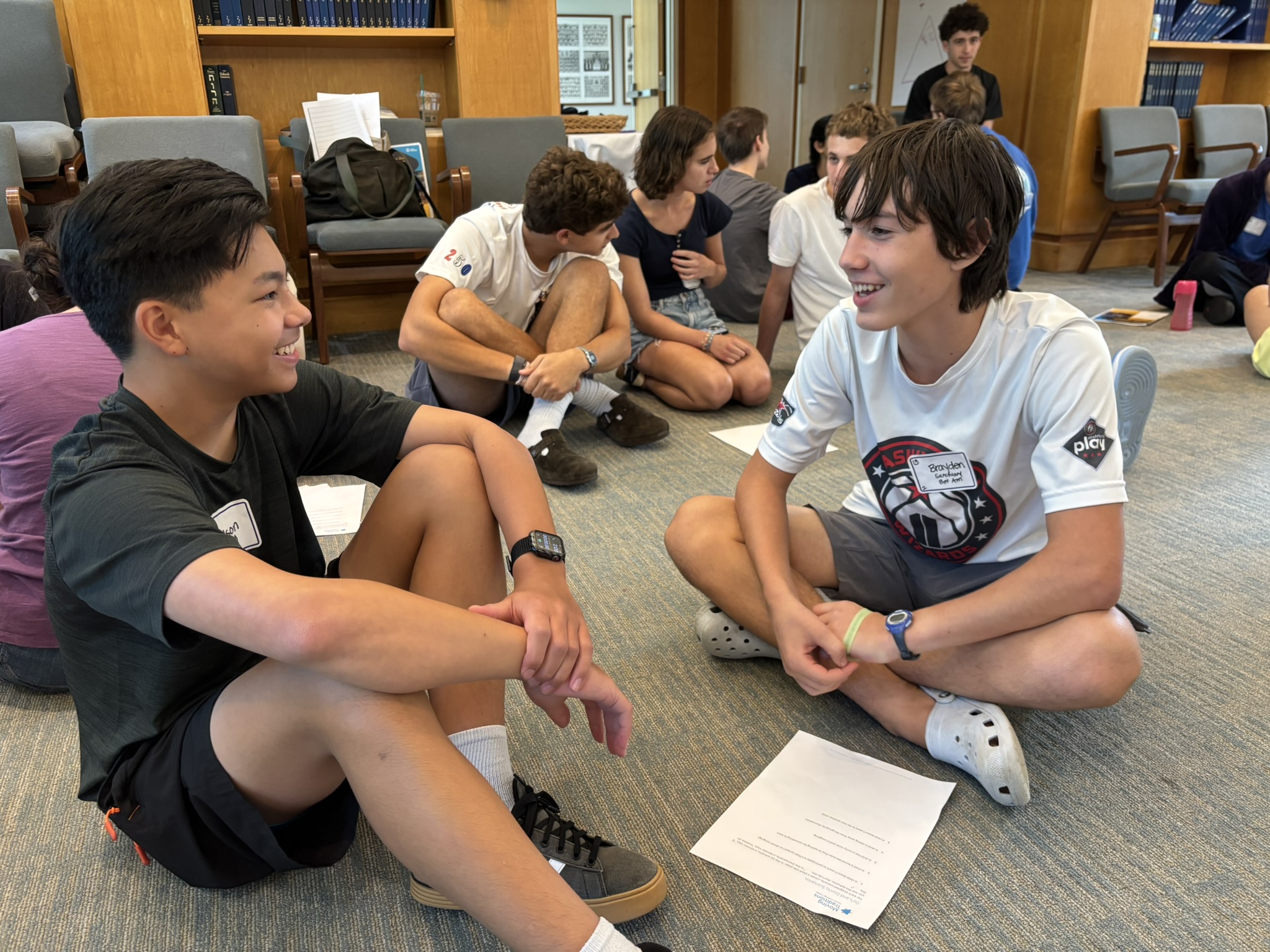
Moving Traditions’ Community Teaching Assistant (TA) Programs help teens develop professional skills within a Jewish context to support their social, emotional, and spiritual growth, and help younger students do the same. Through in-person and virtual offerings, participants have the chance to connect with other Jewish teens and build a strong community.
As a Pilot Program, we are currently offering the Community TA Program in MetroWest New Jersey, Northern New Jersey, and the Greater D.C. area.
MetroWest New Jersey
Now in its third year, our Community TA program in Metro West has grown into a vibrant training ground for teen leaders, with more than 30 teens enrolled this year and over 80 teens reached since it began.
Using a case-study approach borrowed from teacher training, teens practice real-world skills like giving and receiving feedback, de-escalating conflict, setting boundaries, and knowing when to handle a situation themselves and when to ask for help. The result is a classroom where younger students are supported not only by their Jewish educator but by teen assistants who are prepared to be true partners in their learning. By investing in these teens, we’re strengthening Jewish education across the Metro West, both for the children in the classroom and for the teen leaders who carry these skills forward.
Participating synagogues:
- B’nai Keshet
- Congregation Beth Israel (Scotch Plains)
- Pine Brook Jewish Center
- Temple Beth-El Mekor Chayim
- Temple Har Shalom
- Temple Sholom of West Essex
Northern New Jersey
This year, we’re excited to launch our Community TA program in Northern New Jersey, bringing together teens from congregations across the region to learn, grow, and connect.
Through skill-building sessions and case-study discussions modeled on how teachers are trained, teens explore the kinds of situations they’ll face in the classroom and learn to see mistakes as opportunities for growth. They build communication skills like speaking up, listening actively, and offering feedback, and gain a deeper understanding of the social and emotional lives of the kids they work with. That preparation matters: when teen teacher assistants step into the classroom ready to mentor, guide, and care for younger students, they become a meaningful part of the learning experience.
In this way, the program strengthens Jewish education in congregations across the region while giving teens from different communities the chance to meet, share their perspectives, and build friendships beyond their own congregations.
Participating Synagogues:
- Coming Soon!
D.C. Area
This year, we’re excited to launch our Community TA Program in the Washington, DC area, bringing together 34 teens from congregations across the region to learn, grow, and connect.
Through skill-building sessions and case-study discussions modeled on how teachers are trained, teens explore the kinds of situations they’ll face in the classroom. Along the way, they develop as leaders: they practice speaking up, listening actively, and offering feedback, and gain a deeper understanding of the social and emotional lives of the kids they work with. When teen teaching assistants step into the classroom ready to mentor, guide, and care for younger students, they become a meaningful part of the learning experience, and they carry those leadership skills with them well beyond it.
In this way, the program strengthens Jewish education in congregations across the DC region while giving teens from different communities the chance to meet, share their perspectives, and build connections beyond their own congregations.
Participating Synagogues:
- Congregation Beth El of Montgomery County
- Beth El Hebrew Congregation
- Temple Sinai
- Tifereth Israel Congregation
- Temple Shalom
- Adat Reyim Congregation
- Hill Havurah
- Temple Emanuel
- Washington Hebrew Congregation
Impact
When we asked teen participants about their experiences:
96% felt better prepared to be a TA
95% learned something that would help them handle situations with their students
94% learned communication skills to use with their students during the school year
“I learned how to talk to students when they are feeling stressed and how to de-escalate the situation.”
“I learned that our own beliefs and discomforts may prevent us from seeing the full picture.”
“I hope to bring back the skill of accommodating my students and their varying learning needs. I’ll use what I learned today to include all students and make sure they can learn in a way that suits them.”
Funding Partners