


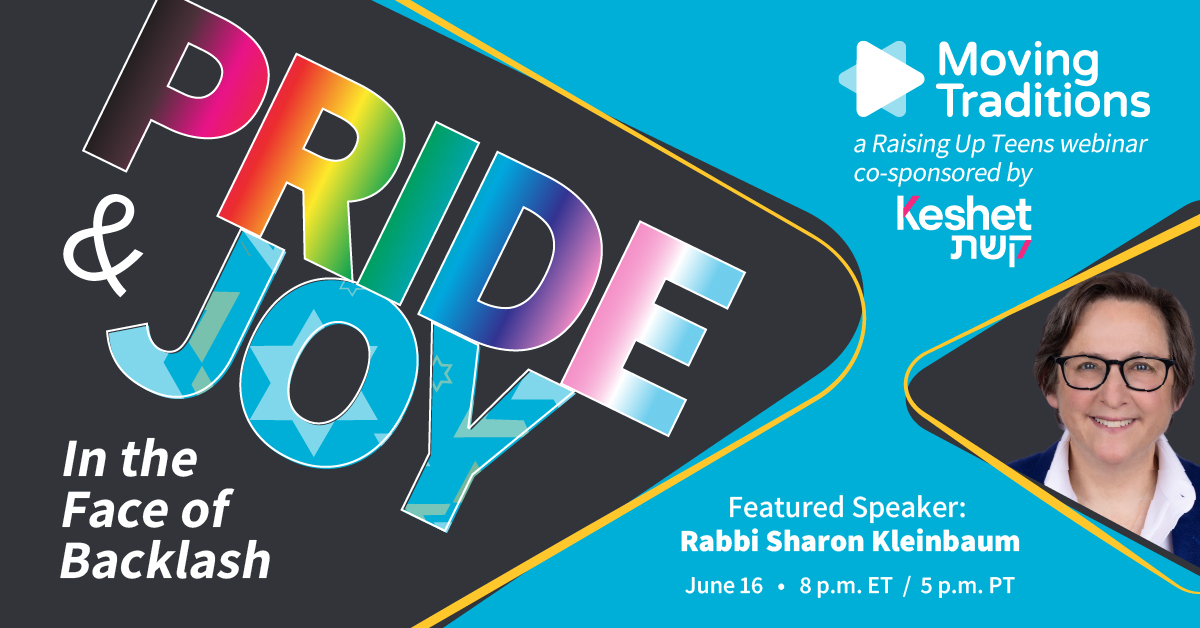
On June 16, Moving Traditions hosted a webinar for parents and educators of Jewish youth. In Pride and Joy In the Face of Backlash, co-sponsored by Keshet, we talked about how to show up for the queer Jewish youth in our lives and communities with honesty, love, and hope.
Thank you to our panel of experts who approached this topic from legal, Jewish, and youth perspectives, featuring:
- Rabbi Sharon Kleinbaum, one of America’s most celebrated LGBTQ+ Jewish leaders
- Jaimie Krass, President and CEO of Keshet
- Ollie Small, jGirls+ Magazine alum
- Molly R., Kol Koleinu returning fellow
- Rabbi Tamara Cohen, Chief of Program & Strategy at Moving Traditions
- Rabbi Daniel Brenner, (he/him), VP of Education at Moving Traditions (moderator)
Watch the Recording
Resources from Moving Traditions
Blessing of the Children
Download our blessing card, which includes masculine, feminine, and nonbinary language from Moving Traditions’ B-Mitzvah Family Education program.
Pride Text study: Parashat Balak
INTRODUCTION
Often as Pride approaches in June, Jews around the world are reading from Parashat Chukkat-Balak, a section from the Torah, which this year we are reading on June 27. The Torah portion has special resonance for queer identities. We invite you to learn the following excerpt with your teen, which leads into a discussion about the blessings of being different.
BACKGROUND
This parasha (Torah portion) tells the story of Balaam, a prophet whom the King of Moab hires for money to curse the children of Israel. Balaam takes the job, but with a stern warning to the King of Moab that he will only speak words of truth, not just what the king pays him to say. The King of Moab agrees to these terms, perhaps hoping his money will win out, despite Balaam’s caveat. Upon seeing the massive Israelite community, Balaam is indeed moved by the Divine to speak words of blessing instead of curse. The text study contains Balaam’s first blessing. He will go on to bless the Israelites three separate times, much to the King’s disappointment.
DISCUSS
- Do you experience pride in your queer identity? What about your Jewish identity? If so, when? If not, why do you think that is?
READ the text below.
Bamidbar (Numbers) 23:8-10
How can I curse whom God has not cursed,
How doom when God has not doomed?
As I see them from the mountain tops,
Gaze on them from the heights,
Here is a people that dwells apart,
Not counted among the nations,
Who can number the dust of Jacob,
Count the dust-cloud of Israel?
May I die the death of the upright,
May my fate be like theirs!
DISCUSS
- What similarities do you see between this description of ancient Jews and the queer community today? Do you notice similarities between your Jewish and queer identities?
- We read this text as saying it is a blessing to dwell apart and not be counted among the nations. In what ways is it a blessing to be separate or distinct?
- Do you relate to your own queer and Jewish identities as a blessing? Why or why not?
- What do you think the story of Balaam can teach us today about how to respond to others’ negative words against us, as Jews and/or as queer people?
- Have you heard messages that God or religion disapproves of queer people? If so, where and what was that like for you?
Note to parents: Your children may be familiar with Vayikra (Leviticus) 18:22, which is often quoted as proof that Torah prohibits sex between men. If this comes up, you can note that these words can be interpreted in many ways. For further reading, we invite you to browse Keshet’s resources on this verse.
CONCLUSION:
In our time, we are probably all aware that queer people have enemies, some of whom are as powerful as the King of Moab. Many of them have political power, spiritual influence, and money. They can say harmful and untrue things about queer people.
Torah, however, teaches us that all people are created b’tzelem Elohim, in the image of God. Queer Jews have always been part of spiritual life. Many people understand some characters in the Torah to have been gay, lesbian, intersex, or transgender – such as King David (whom some interpret to be gay), Ruth (whom some interpret as lesbian), and Abraham and Sarah (whom some interpret to be intersex).
We also have a traditional blessing to thank God for creating diverse human beings:
בָּרוּךְ אַתָּה יְהֹוָה אֱלֹהֵינוּ מֶלֶךְ הָעוֹלָם, מְשַׁנֶּה הַבְּרִיּוֹת
Baruch atah Adonai Eloheinu melech haolam m’shaneh habriyot.
Blessed are You, God, Ruler of the Universe, who makes creatures different.
In Jewish tradition, encountering human diversity is seen as cause to stop and thank God!
Since the beginning of queer history, just like since the beginning of Jewish history, there have been people in positions of power who have wanted to curse us. We are a people who, to some extent, dwell apart from the majority. Just because someone in power or someone with money doesn’t like us, however, that doesn’t that what they say is true. We can stand up for the higher truth, as can our allies, like Balaam (who was not Jewish) did. Jewish text and tradition over and over again affirm the higher truth that queer Jews have always been here, are created in a holy image, and have unique gifts to offer.
Craft: Rainbow Blessing
MATERIALS
- Strips of colored paper, one for each color in the rainbow (red, orange, yellow, green, blue, purple) – some people also use pink, white, brown, and black
INTRODUCTION
Do you know why the rainbow is a symbol for LGBTQ people, or what the different colors stand for?
The rainbow became a symbol for LGBTQ people in 1978, when artist Gilbert Baker designed the first Pride flag. He chose a rainbow because it includes many different colors living side by side, kind of like the LGBTQ+ community, which includes lots of different identities and experiences. Over time, the rainbow flag has become a way to show LGBTQ+ pride, visibility, and solidarity.
Originally, each stripe had its own meaning. You’ll notice some of the original colors have dropped away over time:
- Pink = Love
- Red = Life
- Orange = Healing
- Yellow = Sunlight
- Green = Nature
- Turquoise = Magic and Art
- Indigo = Serenity
- Violet = Spirit
INSTRUCTIONS
We’re going to write a blessing for being LGBTQ. On each strip of paper, write your own blessing for queer community. A blessing can be a statement of gratitude, a wish for the future, a hope, etc. You can use your color’s meaning as inspiration if that helps, or you could write on whatever theme you want. You can use the language of God or a higher power if you relate to that, or keep it more general.
Note to parents: You can each make a flag, or work together to create one. If you are not LGBTQ yourself, you can write a blessing for your child on each color!
DISCUSSION QUESTIONS
- How do you personally feel about the rainbow as a symbol for queer pride?
- How did it feel to write a blessing in this format?
Note to parents: We recommend coming back to the flag blessings in moments of need. Read it again if the news cycle has been tough, if your child has encountered queerphobia recently, or after a difficult moment.
Additional Resources
Keshet: For LGBTQ+ Equality in Jewish Life
In addition to co-sponsoring this webinar, Keshet runs many initiatives in support of trans and queer Jews. We invite you to explore Keshet’s Resources and Events, including a Pride 2026 Digital Resource Packet.
With All My Heart: Torah for Our Times by Rabbi Sharon Kleinbaum
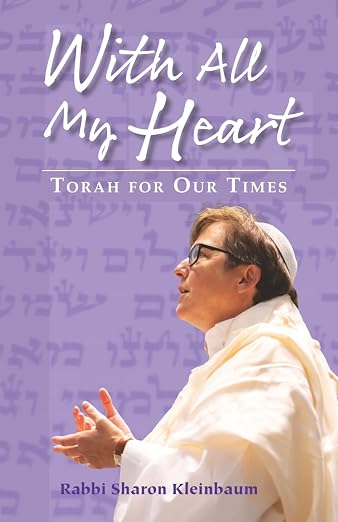
With All My Heart: Torah for Our Times is a collection of twenty inspiring sermons by Rabbi Sharon Kleinbaum, who served as senior rabbi of Congregation Beit Simchat Torah, the world’s largest LGBTQ synagogue, for thirty-two years. Her wisdom, compassion, and deep love of Judaism, and her unwavering commitment to promoting social justice, LGBTQ and human rights, and progressive values within Judaism are at the core of her teachings.
Steeped in Torah, spirituality, and Jewish history, Rabbi Kleinbaum offers a compelling guide for living a meaningful, engaged, and joyous life, with gratitude and hope—in the best and the worst of times.