


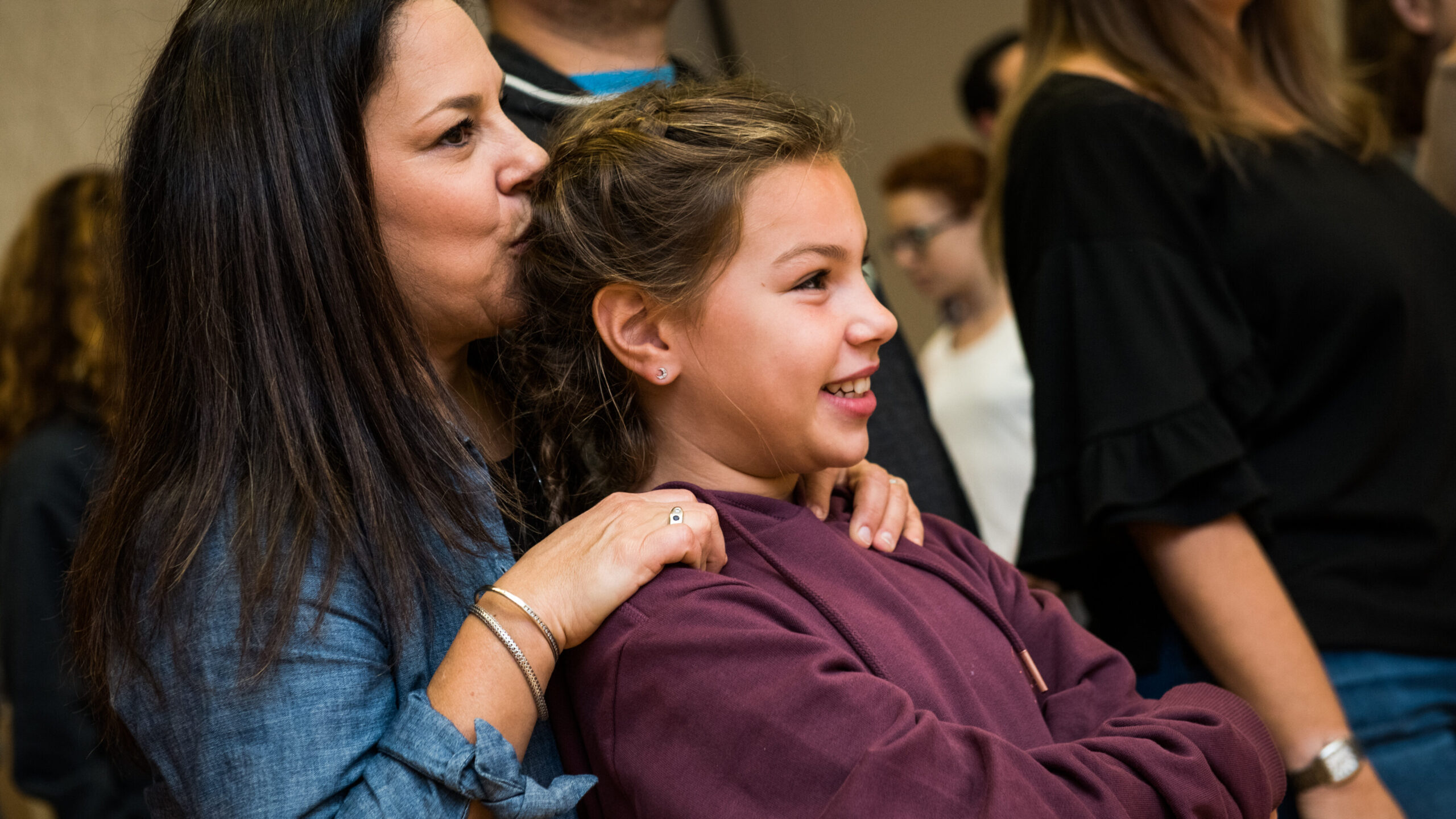
Looking for families to pilot NEW Rosh Hodesh Parent/Daughter Groups!
Moving Traditions is excited to pilot a new way to gather in community to support girls and their parents – through parent-led Rosh Hodesh groups for parents and middle-school-aged daughters. The groups will be open to all self-identified girls and/or nonbinary middle schoolers and their parent or other trusted adults.
We will provide a curricular arc and educational materials for 6-8 sessions, designed to help both teens and parents navigate the complexities of these years. These sessions, framed by Jewish wisdom, allow time for both intergenerational and age-specific activities and discussions.
Moving Traditions will offer training and support to parents who wish to facilitate these groups, or help identify facilitators.
We are recruiting now for the 2026/27 school year! Interested?
We would love to include your family’s perspective as we build this new program. Please take 5-10 minutes to answer a survey:
Or, please reach out to Elizabeth Mandel to express interest.
Session Overviews
| Session Title | Objectives: Participants will . . . |
|---|---|
| Opening Session: Parent, Daughter, and the Moon | — Be introduced to the history and traditions of Rosh Hodesh and consider how the Rosh Hodesh ritual might be personally meaningful to them. — Understand what to expect for the next few sessions – including group norms, schedule, and logistics — Share experiences of being teen girls with one other. |
| Havdalah and Being in Community Together | — Experience the ritual of Besamim (spices) in Havdalah as a tool for emotional comfort and transition to help them bridge the gap between the support of community and potential aloneness of the week. — Practice relational skills by making collective decisions (parent/daughter) on a shared ritual object, mirroring the compromises needed in a healthy community. — Reflect on specific emotional and relational needs during the middle school journey (e.g., Bat Mitzvah prep, social changes) and recognize how leaning into Jewish communal spaces can provide a vital sense of strength and belonging. |
| High Holidays: Being Intentional as Individuals and as a Group | — Define and distinguish between the “automatic” and the “intentional” parts of their lives. — Normalize the human reality that 100% intentionality is impossible and counter productive. — Use the sounds of the Shofar as a metaphor for returning to intention after a “break.” |
| Gossip, Lashon Hara, and Ethical Speech | — Explore the Jewish prohibition against lashon hara (unethical speech), where they notice it in their own lives, and distinguish between what is harmful gossip and what is connective bonding through storytelling. — Discuss what makes it difficult to avoid lashon hara and consider times when it may be beneficial and healthy to vent about a hurtful or complicated friend situation. |
| Competition and Comparison | — Use the Midrash of the Sun and Moon to reflect on how comparison can lead to “shrinking” ourselves within the context of our relationships. — Identify their personal “superpowers” and the specific qualities they wish to reflect outward into their community. — Apply the Mussar concept of Anavah—taking up “no more than my space, no less than my place”—to navigate the pressure of external expectations and social comparisons. |
| Darkness and Sundown: Resilience Toolkit | — Explore how to view periods of “darkness” (anxiety, sadness, or the unknown) not as permanent states, but as natural phases of a cycle, modeled by the Jewish lunar calendar and the story of Adam’s first winter. — Identify and practice specific coping strategies—rooted in both Jewish ritual and personal family history—to proactively manage “dark” or anxious moments in relationship with their daughters/parents (like the “Sunday Scaries” or developmental milestones). |
| Purim, Identity, Social Pressure, and How We Present Ourselves | — Be introduced to a midrash about Esther’s story and use it as a jumping off point to explore the tension between wanting to fit in and staying true to themselves. — Identify social and societal pressures that they face to look or act a certain way as a Jewish girl/woman — Through a hands-on art activity, reflect on what helps them connect with themselves as Jewish girls/women and feel confident in their own skin. |
| Pesach: Looking Beyond Myself | — Seek inspiration from the story of Shifra and Puah/Miriam and Yoheved, using the midwives’ intergenerational teamwork as a mirror for their own unique relationship. — Discuss the balance between Preservation (honoring tradition/order) and Innovation (challenging the status quo/disruption) within their relationship and family dynamics. — Co-create a tangible story recording or symbolic object (like a decorated tambourine) that represents their family’s contribution to the ongoing Passover narrative of resistance and resilience. |