|
The Campaign for Jewish Boys
Help Name our New Program
Why Boys Need This
Bridge to Jewish Identity
Roundtable Themes
Survey for Jewish Educators
Articles
Thanks
The Campaign for Jewish Boys
Through The Campaign for Jewish Boys, Moving Traditions seeks to reverse boys’ mass exit from and dissatisfaction with Jewish life by:
a. educating the Jewish community – thought leaders, educators, clergy, and funders – to better understand and meet adolescent boys’ needs
b. sparking boys’ interest and maintaining their participation in Jewish life
c. building boys’ Jewish identity
Curriculum. Moving Traditions is drawing on our research to develop a boy-friendly and high-quality Boys’ Program that can be replicated in a variety of settings – complementary schools, youth groups, camps, etc. The informal curriculum is presented in six two-hour modules for Jewish 8th and 9th grade boys of all affiliations. The curriculum can be incorporated into a current program or offered on a stand-alone basis. The curriculum includes:
a. Enjoyable activities that create safe space and enable boys to engage in meaningful discussion.
b. Content that draws on Judaism and gives boys the opportunity to explore issues they care about, such as friendship, sex, power, money, and work.
c. Resources to help educators and youth workers facilitate meaningful conversations with boys.
Our research and curriculum development team is now in the first stage of pilot-testing the curriculum. If you are interesting in helping Moving Traditions in the second stage of pilot testing in the spring of 2010, please contact
This e-mail address is being protected from spam bots, you need JavaScript enabled to view it
, Director of Education and Program.
Framework for Working with Jewish Boys. Along with curriculum development, Moving Traditions is conducting action-research, investigating the most effective ways to make it possible for boys to enjoy and meaningfully engage with Jewish content as they explore essential existential questions. In this way we believe they will see Judaism as relevant to their lives. We will publish the findings in our report, the Framework for Working with Jewish Boys.
Marketing and Recruitment. One of the most challenging aspects of working with teens, and especially teenage boys, is recruitment – getting them in the door. For this reason, Moving Traditions is conducting a marketing analysis of the most effective recruitment and marketing techniques for teenage boys, drawing on marketing expertise in the secular world and analyzing the relative effectiveness of marketing efforts in the Jewish community, locally and nationally. As a result, we will publish a marketing toolkit in the report, the Framework for Working with Jewish Boys.
Help Name Our New Program for Jewish Boys
As we approach another milestone in the development of our new Boys' Program -- the creation of six curriculum units and a report on engaging Jewish teenage boys -- we are eager to give this program a name that launches it to Infinity and Beyond! Or at least, a name that works well in media as well as Jewish households.
We've been thinking, who better to help us name this program than our community of friends and parents of teens? Please exercise your creativity and help us find a name that expresses the mission and value of this effort.We're looking for a name that conveys the concept of engaging Jewish boys after the age of bar mitzvah in a fun experience. Also, the name should be harmonious with Moving Traditions' lens on gender.
Please send your suggestions to us at
This e-mail address is being protected from spam bots, you need JavaScript enabled to view it
. You may send as many suggestions as you like.
You can even send program name ideas that aren't quite right, or are already in use, because your comments may spark more ideas. We'll strive to select a name that is not only inspired, but short and unique.
If we choose your name we will acknowledge your contribution with a $36 iTunes certificate.
Example: Leave No Bar Mitzvah Behind (oops -- that's too long and negative)
Example: Shul 4 Boyz (see -- we really need your help)
Many thanks in advance for your creative input!
Why Boys Need This
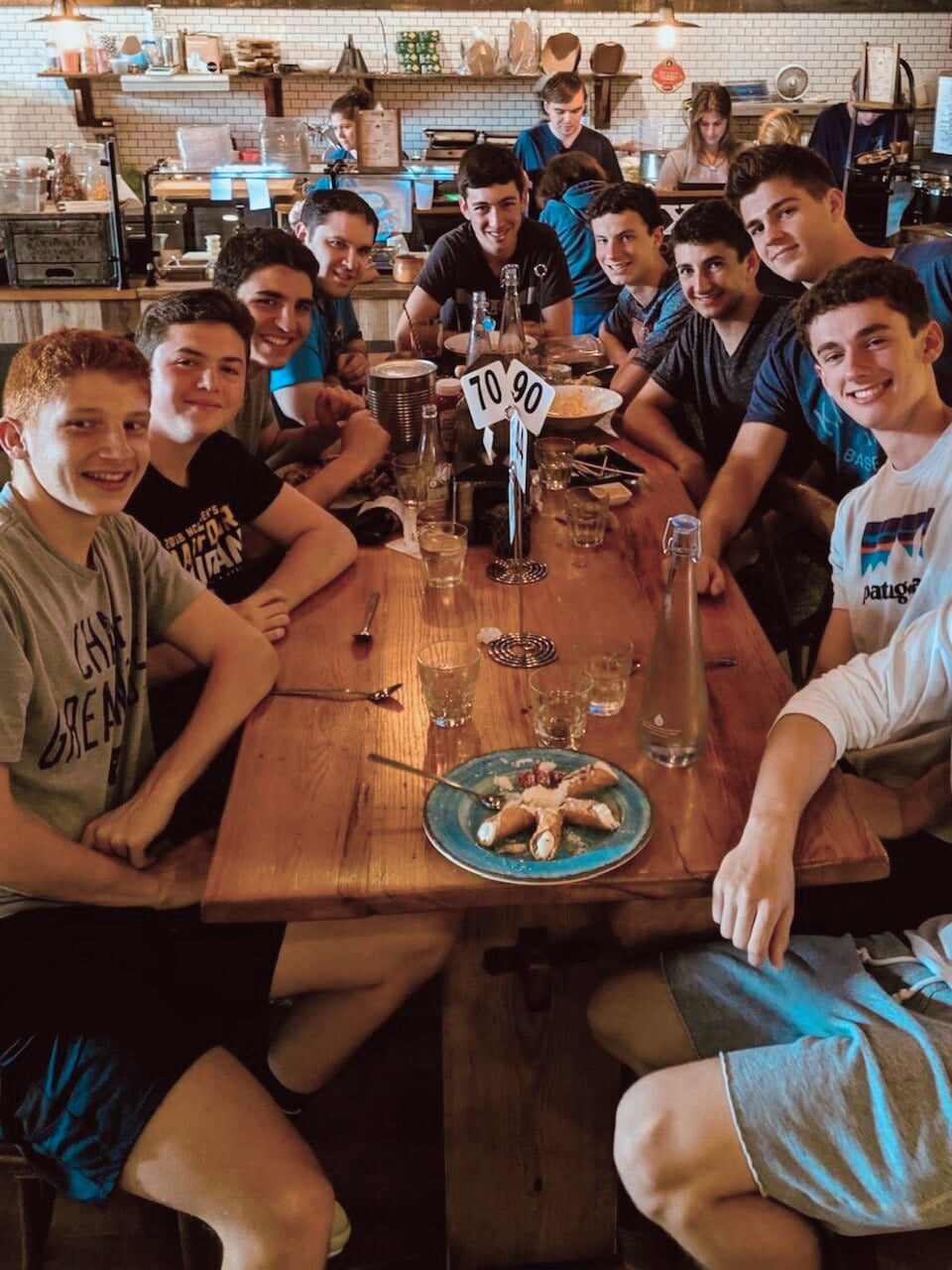
Many boys drop out of Jewish life after bar mitzvah, despite the fact that Judaism has the potential to provide them with values and support as they navigate the journey from boyhood to adulthood.
According to research:
| Attitude toward current Jewish programming: |
Agreed to by % Boys |
Agreed to by % Girls |
| “Bar/Bat Mitzvah was graduation from Jewish school” |
47%
|
34%
|
| “Was the connection to Judaism enhanced by Israel experience programs?” |
32%
|
46%
|
| Jewish-sponsored classes or activities are: “repetitious” and “not meaningful” |
68%
|
60%
|
| Jewish-sponsored classes or activities are: “nothing offered is of interest to me” |
41%
|
32%
|
| Jewish-sponsored classes or activities are: “boring” |
25%
|
17%
|
Meanwhile, boys receive contradictory societal pressures to conform to a hyper-masculine image and to succeed academically.
Dr. William Pollack, in his book Real Boys: Rescuing our Sons from the Myths of Boyhood, describes the pervasiveness of the "Old Code" for boys. This outmoded version of the masculine ideal dictates four desirable attributes: independence, machismo, dominance and stoicism. Yet our culture’s double standard informs these same boys that they should be sensitive and caring.
Click Here to read about Moving Traditions' lecture by Dr. William Pollack.
Raising Cain, by leading child psychologists Dr. Dan Kindlon and Dr. Michael Thompson, describes a similar paradox for boys who are expected to be tough, cool and independent, but who yearn for the support and connections that friendships and relationships can provide.
However, Judaism – which could provide values and support to boys as they grow into men – is not reaching most teenage boys.
Charles Kedushin, Shaul Kelner, Leonard Saxe, Being a Jewish Teenager in America, 2000.
Nancy Leffert and Hayim Herring, Shema: Listening to Jewish Youth, 1998.
Bridge to Jewish Identity
Do teenage boys find meaning in Jewish identity?
In November and December 2007, Moving Traditions conducted focus groups in Denver to begin to determine the impact of Jewish life on adolescent boys.
Researchers found that the “Jewishly-affirming” teenage boys in the sample had greater resilience, more expressive communication styles, and closer male friendships than the less Jewishly-connected boys.
The research was conducted by Dr. Michael C. Reichert and Sharon M. Ravitch, Ph.D. for Moving Traditions as part of its campaign to help the Jewish community better serve Jewish adolescent boys.
One boy explained why he likes getting together with other Jewish guys, “It’s like there’s some connection, there’s some bridge that we already have with each other.”
“What’s interesting is that the “Jewishly-affirming” guys in the study look like many other boys in the secular world – they are involved with sports, have girlfriends, and are successful socially – yet they find something very positive about being Jewish. What they had to say gives us clues for better engaging teenage boys,” said Deborah Meyer, Executive Director of Moving Traditions.
While many of the boys articulated a longing for deeper Jewish connection, they also complained about the offerings available to them through the Jewish community.
“From stale and dogmatic supplemental education, preachy youth outreach, anxious parents or overly secular youth groups, even the boys who were most Jewishly-affirming explained that they had had to construct their Jewish identities despite significant barriers,” the report finds.
The researchers found that:
1. Judaism provides some boys with deep meaning.
2. Judaism provides some boys with resilience, an “alternative” masculinity, and an opportunity to express a sense of self.
3. Jewish experiences were either not entirely satisfactory or unsatisfactory for all of the boys, including those who are currently participating in Jewish life.
4. Most of the boys expressed enjoyment and appreciation for the opportunity to meet and discuss their lives, masculinity, Jewish identity, and their experiences with Jewish life.
In December of 2007, Moving Traditions convened the Roundtable on Jewish Life and the Development of Adolescent Boys with the University of Pennsylvania Graduate School of Education and the Center for the Study of Boys’ Lives.
A cross-disciplinary group of 26 leaders in the fields of adolescent development; education, both Jewish and secular; social science; and marketing uncovered key themes about boys that Moving Traditions intends to further explore:
1. Cool Factor and Self-Selection: Certain boys may seek out the comforts of Jewish life, while others look to opt out based on the “tyranny of cool”
2. Boys Code and Identity Development: Cultural messages and peer pressure push boys to wear “masks of bravado;” the need for “safe spaces” to help boys break out of constrained roles and expectations
3. Importance of Parents and Mentors: There is a need to train educators to be “fluent” in teen development – mentors are a critical pre-requisite for successful positive youth programming; by the same token, many adults are not comfortable exploring gender issues, masculinity, or homosexuality
4. Boy-Friendliness and Social Discomfort: Attention should be given to boys’ developmental needs, learning styles, and interests in programming; boys should be involved in the creation of their own programming
5. Countercultural Pride around Jewish Identity: For some boys, Judaism may be an expression of individual identity, possibly as a way to counter institutional structures / or the tyranny of cool; question as to whether young people consider Judaism as more of an ethnicity than a religion
6. Timing of Interventions: “They are already lost by bar-mitzvah;” unaffiliated teens are difficult to attract, calling for the need to consider earlier interventions; the role of the fallow period in the Jewish journey of many young males, especially prior to marriage; the timing of boys’ developmental milestones relative to girls
7. Marketing Challenges: Difficulty in being explicit with some boys about certain program goals when marketing, such as unmasking; need for marketing that is more teen- and culture-savvy; power of peer-to-peer recruiting
Survey for Jewish Educators
Moving Traditions is interested in introducing and engaging more Jewish educators in our work for Jewish boys. We recently completed the first round of piloting a six-module curriculum for 8th and 9th grade boys and are planning a second round in 2010. Also in 2010, we will be issuing a report for Jewish educators that will include specific recommendations about the most effective ways to engage Jewish boys, no matter the program.
If you are interested in Moving Traditions’ work with boys, we encourage you to complete our Teen Programming Survey. We would like to share our new materials with you when they are available.
Articles featuring The Campaign for Jewish Boys
Where the Boys Aren't -- New York Jewish Week and JTA, January 9,2008
Where Have all the Young Men Gone -- Washington Jewish Week, October 25, 2008
Moving Traditions gratefully acknowledges the outstanding support of the Charles & Lynn Schusterman Foundation which makes this project possible.
We also express appreciation to the individual and foundation funders whose generous support furthers our work:
Jacob & Hilda Blaustein Family Foundation
Natan
Alan B. Slifka Foundation
You can help the Jewish community better reach boys by making an on-line, tax-deductible contribution to Moving Traditions. Thank you.
|